
Brake rotors are one of the most important parts of a vehicle's braking system. Every time you press the brake pedal, the brake pads clamp against the rotor to create friction and slow the vehicle.
Because rotors operate under repeated friction and heat, they gradually wear and can eventually develop problems that affect braking performance. Knowing when to replace brake rotors can help prevent poor braking performance, unnecessary component wear, and potentially serious safety problems.
The important thing to remember is that brake rotors do not have one universal replacement interval. Their service life depends on the vehicle, rotor design, driving habits, brake pad material, road conditions, heat exposure, and the manufacturer's specified wear limit.
So instead of replacing rotors based only on mileage, drivers should pay attention to their condition and the symptoms they produce.
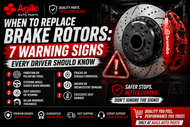
Here are seven important brake rotor replacement signs every driver should know.
1. The Brake Pedal Pulsates When Braking
One of the most recognizable signs of a potential rotor problem is a pulsating brake pedal.
If the brake pedal feels smooth during normal braking but begins moving or pulsing as the vehicle slows down, the braking system should be inspected.
This sensation can be associated with rotor thickness variation or excessive lateral runout. Technical service information published through NHTSA describes brake pedal pulsation as a possible result of excessive brake disc thickness variation. Another NHTSA-hosted technical bulletin explains that rotor thickness variation and runout can cause the brake pads to move as they follow uneven areas of the rotor, which can be felt through the brake pedal.
However, a pulsating pedal does not automatically prove that the rotor itself is defective. Wheel hub condition, installation, bearing condition, and other components can contribute to runout or uneven braking.
That is why proper inspection and measurement are important before replacing parts.
2. The Steering Wheel Vibrates During Braking
Another common symptom is steering wheel vibration when braking, particularly during moderate or hard stops.
If the steering wheel remains relatively smooth during normal driving but begins to shake when you apply the brakes, the front braking system should be inspected.
Severe rotor runout or thickness variation can transfer vibration through the brake system and into the steering system. NHTSA-hosted technical information notes that rotor thickness variation can be felt as brake pedal pulsation and, in more severe cases, can also produce steering wheel oscillation.
This is an important distinction because steering vibration can have other causes as well. Wheel balance, tires, suspension components, wheel bearings, and other parts can create vibration.
If the vibration specifically appears or becomes much stronger when braking, the rotors and complete front brake assembly deserve attention.
3. Deep Grooves or Severe Scoring Appear on the Rotor
A brake rotor's friction surface should remain reasonably smooth and consistent.
Over time, normal wear can create some surface changes. However, deep grooves, severe scoring, or significant surface damage are warning signs that the rotor needs professional inspection.
HELLA's brake service guidance states that brake discs should be replaced when they are strongly grooved, cracked, warped, strongly corroded, or worn to the specified minimum thickness.
Deep scoring can also indicate a problem involving the brake pads. For example, severely worn pads or contamination can damage the rotor surface.
Replacing only the rotor without identifying the reason for the damage may allow the underlying problem to continue.
This is why rotor inspection should be performed together with an inspection of the brake pads, calipers, hardware, and other relevant components.
4. The Rotor Is Below Its Minimum Thickness
This is one of the most important and measurable brake rotor replacement signs.
Brake rotors have a specified minimum allowable thickness. This limit is established by the manufacturer and should not be ignored.
HELLA explains that the minimum thickness, commonly identified as "MIN TH," defines the wear limit of a brake disc. The specification may be marked on the rotor itself, and the rotor should be replaced when its measured thickness reaches or falls below that specified limit.
This means you should not rely on appearance alone.
A rotor can look reasonably good but still be too thin for continued service. Conversely, a rotor may have visible surface discoloration or light wear without automatically requiring replacement.
A technician can measure the rotor at the appropriate points and compare the lowest measurement with the vehicle or rotor manufacturer's specification.
This is especially important when servicing high-performance vehicles where braking components may experience greater thermal loads.
5. You See Cracks or Serious Corrosion
Cracks in a brake rotor should never be treated as a cosmetic issue.
A cracked rotor requires replacement and should not be continued in service.
Severe corrosion can also compromise the rotor's usable friction surface and overall condition. HELLA specifically identifies strongly corroded and cracked brake discs among the conditions requiring replacement.
Some surface rust can appear naturally on cast-iron brake rotors, particularly after the vehicle has been parked in humid or wet conditions. Light surface rust that disappears after normal braking is not necessarily a reason to replace a rotor.
The concern is significant corrosion, pitting, damage, or deterioration that affects the friction surface or component integrity.
If corrosion is severe enough to create an uneven or compromised braking surface, the rotor should be professionally evaluated.
6. Braking Performance Feels Uneven or Inconsistent
Your vehicle should respond predictably when you apply the brakes.
If braking feels inconsistent, the vehicle pulls to one side, stopping performance changes as the brakes heat up, or the brake pedal behavior changes noticeably, the complete braking system should be inspected.
Rotor problems can contribute to inconsistent braking, but this symptom can also be caused by brake pads, calipers, hydraulic problems, tires, suspension components, or other issues.
For that reason, drivers should not automatically assume that every braking problem is caused by the rotor.
The goal is to identify the actual cause before purchasing replacement parts.
This is particularly important for performance vehicles. A vehicle used for spirited driving, towing, mountain roads, track use, or repeated heavy braking can place significantly different demands on its braking system compared with a vehicle used primarily for short city trips.
7. The Rotors Have Excessive Heat Damage
Brake rotors are designed to absorb and release significant amounts of heat.
Repeated heavy braking can create extremely high temperatures, and excessive heat can contribute to changes in the rotor surface and braking behavior.
Visible signs such as severe heat discoloration, cracking, scoring, or other physical damage should prompt an inspection.
It is also important to understand that not every change in rotor color automatically means the rotor must be replaced. Heat-related appearance should be evaluated alongside rotor thickness, runout, surface condition, cracks, and the vehicle manufacturer's specifications.
For performance applications, proper rotor selection becomes even more important because different brake systems are designed around different levels of heat management and braking demand.
How Long Do Brake Rotors Last on a Performance Car?
One of the most common questions is, "How long do brake rotors last?"
There is no single mileage number that applies to every vehicle.
A performance car driven primarily on highways may experience very different rotor wear from the same vehicle driven aggressively on mountain roads. A vehicle used for towing or repeated heavy braking will also place different demands on its rotors.
Brake pad compound, rotor design, vehicle weight, driving conditions, climate, road contamination, braking habits, and maintenance can all influence service life.
For this reason, replacing rotors strictly at a predetermined mileage is not always the best approach.
Instead, monitor the rotor's measured thickness and physical condition, and follow the service information specified for your vehicle.
If a rotor has reached its minimum thickness, developed cracks, severe grooves, significant corrosion, or other unacceptable damage, it should be replaced regardless of mileage.
Can You Resurface Brake Rotors Instead of Replacing Them?
In some situations, resurfacing may be considered, but it is not automatically the right solution.
The rotor must have enough remaining thickness to remain above the manufacturer's minimum specification after machining. If resurfacing would take the rotor below the allowable thickness, replacement is required.
NHTSA-hosted manufacturer service information demonstrates this principle by requiring rotor thickness measurements before and after machining and requiring replacement when the resulting thickness would be below the minimum specification.
Modern vehicles and performance applications also make it especially important to follow the specific service instructions for the vehicle and brake system.
A technician should determine whether resurfacing is appropriate based on the rotor's condition and specifications rather than assuming every rotor can simply be machined.
Should Brake Rotors Be Replaced in Pairs?
When replacement is required on an axle, rotors are generally replaced as a pair so that braking characteristics remain consistent from side to side.
HELLA's brake service guidance states that brake discs should be replaced in pairs.
This does not necessarily mean all four rotors must be replaced at once.
For example, if the front rotors require replacement while the rear rotors remain within specification and are in good condition, the service may be limited to the front axle.
Always follow the vehicle manufacturer's service requirements and have the entire braking system inspected.
What Should You Check Before Buying New Brake Rotors?
Before ordering replacement rotors, confirm the exact application.
Check the vehicle year, make, model, engine or trim where applicable, axle position, rotor diameter, thickness, vented or solid design, mounting configuration, and any other application-specific requirements.
For performance vehicles, also consider how the vehicle is actually used.
A daily driver may have different requirements from a vehicle used for autocross, track events, towing, mountain driving, or other demanding conditions.
Do not choose a rotor solely because it looks similar to the original component or because it has a lower price.
The correct rotor must match the vehicle and braking system.
What About Brake Pads When Replacing Rotors?
When replacing rotors, the brake pads should also be inspected carefully.
If the existing pads are worn, contaminated, damaged, or unsuitable for the new braking setup, they may need replacement as well.
HELLA notes that new brake pads should only be installed when the brake disc remains above its specified minimum thickness.
When installing a new rotor and new pads, proper bedding procedures should also be followed according to the brake component and vehicle manufacturer's instructions.
Proper installation matters just as much as choosing the right parts.
The wheel hub and rotor contact surfaces should also be clean and free from dirt or corrosion because uneven contact at the hub can contribute to rotor runout. HELLA specifically notes that unevenness at the hub contact surface can lead to brake disc runout.
The Bottom Line
Knowing when to replace brake rotors is less about following a universal mileage schedule and more about understanding the condition of the braking system.
The seven warning signs to watch for are brake pedal pulsation, steering wheel vibration during braking, deep grooves or severe scoring, rotor thickness at or below the minimum specification, cracks or serious corrosion, inconsistent braking behavior, and significant heat-related damage.
Some of these symptoms can have causes other than the rotor, so proper inspection is essential before replacing components.
For drivers who depend on strong and predictable braking performance, regular brake inspections are worth taking seriously. If your rotors are approaching their wear limit or showing signs of damage, replacing them with the correct high-quality brake components can help restore the braking system to proper operating condition.
When shopping for replacement brake components, choose products that match your exact vehicle and intended use. Agile Auto Parts offers genuine brand-name and performance brake components from recognized manufacturers, giving drivers access to replacement and upgrade options for a wide range of applications.
Shop Brake Parts at Agile Auto Parts: Brake Parts Category
Check the exact vehicle application and product specifications before ordering, especially for performance brake systems.
Sources and Technical References
The technical information in this article was checked against brake service guidance from HELLA and manufacturer technical service information published through NHTSA.